How Lulu PV’s 50kW Commercial ESS Conquers Grid Instability in Nigeria

From Engineering Precision to Commercial Value: A Deep Dive into Successful “De-Dieselization”

When Stable Power is a Luxury

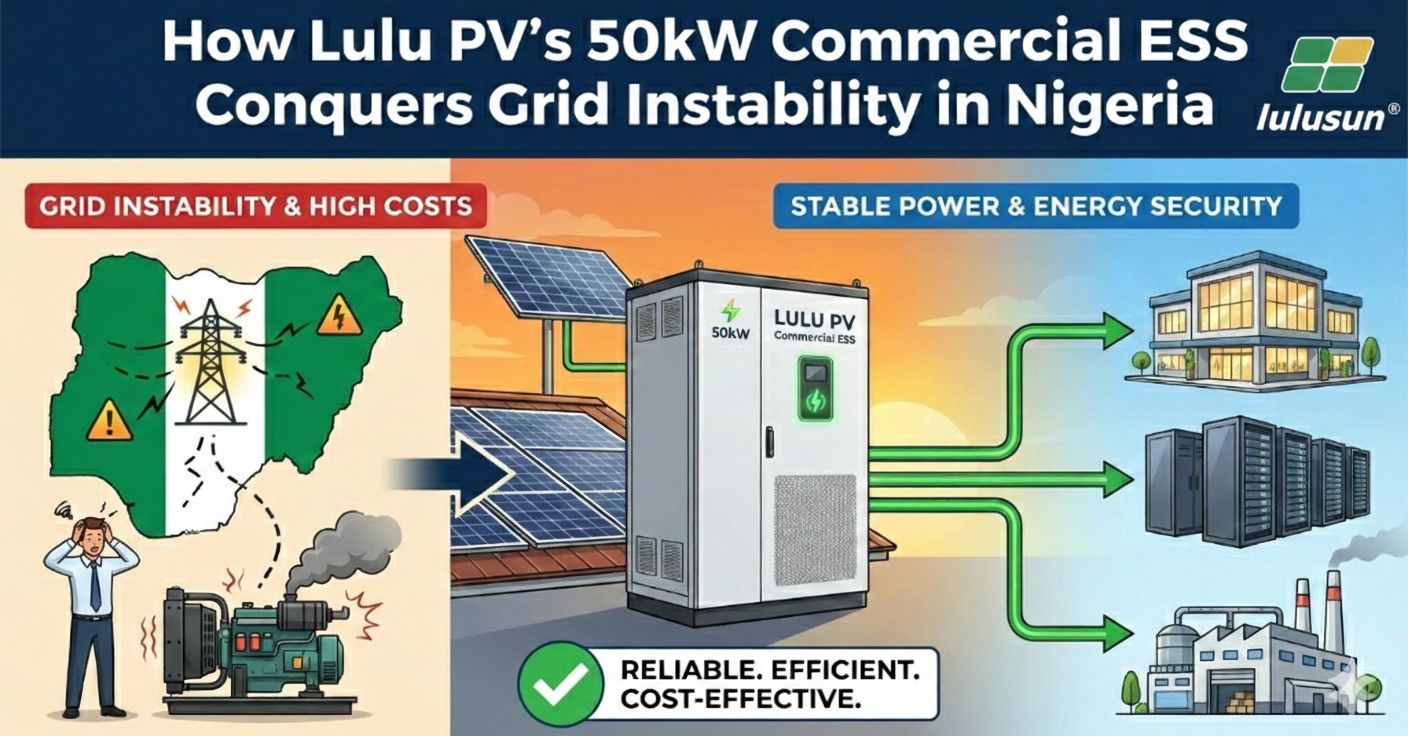
For many Commercial & Industrial (C&I) businesses in Nigeria, grid instability isn't just an inconvenience—it is a massive operational cost. Frequent outages force enterprises to rely heavily on expensive, noisy, and polluting diesel generators just to keep the lights on.

Recently, Lulu PV successfully deployed a 50kW Commercial Energy Storage System (ESS) in Nigeria. This case represents more than just a project delivery; it is a perfect validation of how high-performance storage can completely transform an enterprise's energy structure, even in the most extreme grid environments.

Drawing from our actual field case in Nigeria (50kW/100kWh configuration) and our core product, the LU 50kW/112kWh All-in-One, this article dissects the technical logic and commercial value of this solution from the dual perspectives of a Senior Engineer and a Sales Expert.

Project Record

  • Location: Nigeria

  • Core Challenge: Extremely unstable municipal power supply, skyrocketing diesel generation costs, and an urgent need for continuous production/operation.

  • Solution Core: Lulu PV 50kW C&I Energy Storage System (Configured with approx. 100-112kWh High-Voltage Lithium Battery Bank).

  • System Functions: Millisecond-level backup power switching, diesel generator replacement, and peak-shaving (depending on local policy).

Perspective 1: The Engineer's Analysis (Technical Reliability)

As a technical team, our core focus is: How do we ensure "Absolute Reliability" in an environment like Nigeria, characterized by high heat, high humidity, and a fragile grid?

1. "All-in-One Design" for Harsh Environments

In regions with weak infrastructure, complex on-site wiring and integration are common points of failure. Our LU 50kW/112kWh utilizes a highly integrated design.

  • Technical Advantage: The 50kW hybrid inverter, High-Voltage BMS (Battery Management System), EMS (Energy Management System), and thermal management system are pre-integrated into a single industrial-grade cabinet. This not only shortens on-site installation time by over 40% but, more importantly, ensures system-level testing is completed before leaving the factory, drastically reducing integration risks.

2. Rock-Solid LiFePO4 Technology

Considering Nigeria's tropical climate, battery thermal stability is critical.

  • Technical Advantage: We utilize top-tier Lithium Iron Phosphate (LiFePO4) cells. Compared to Ternary Lithium, LiFePO4 has a much higher thermal runaway threshold, making it safer in high-temperature environments. Paired with an efficient industrial-grade temperature control system (such as air conditioning or liquid cooling), we ensure the cells always operate within their optimal temperature range, guaranteeing a long cycle life of over 6,000 cycles.

3. Millisecond On/Off-Grid Switching

For commercial users, a one-second power outage can mean data loss or a scrapped production line.

  • Technical Advantage: The core 50kW hybrid inverter of this system possesses strong load-bearing capacity and an ultra-fast response mechanism. When the grid fails, the system seamlessly switches to battery power in UPS-level time (typically <20ms). Critical loads remain completely unaffected.

Perspective 2: The Sales Analysis (Commercial Value)

From a market and Client ROI (Return on Investment) perspective, this case isn't just about selling equipment; it's about selling "Energy Security" and a "Cost Control Solution."

1. Core Selling Point: Ending "Diesel Dependence"

In Nigeria, the cost per kWh of diesel generation is often multiples of grid electricity. This is the client's biggest pain point.

  • Commercial Value: With a 50kW/100kWh+ configuration, businesses can store solar energy (if PV is present) or cheaper grid power during the day and discharge it during outages. Every kWh drawn from the battery is one less kWh of diesel burned. For regions with frequent outages, the ROI period for this system is surprisingly short—often recovering costs within 3-5 years.

2. Hidden Revenue from Business Continuity

For hospitals, data centers, or manufacturing plants, the indirect losses caused by power outages often far exceed the electricity bill itself.

  • Commercial Value: The Lulu PV system provides more than just power; it provides "Business Continuity Insurance." Ensuring 24/7 uninterrupted operations enhances brand reputation and avoids downtime losses—a massive value that is hard to quantify in mere currency.

3. Scalability and Future-Readiness

50kW is a highly flexible entry point for C&I applications.

  • Commercial Value: Our system supports modular expansion. Clients can start with the current 100kWh or 112kWh and, as their business grows or backup duration requirements increase, easily parallel more battery modules without scrapping their existing investment. This is a future-proof asset.

Conclusion: Empowering the C&I Energy Transition

The Nigeria case powerfully proves that Lulu PV’s 50kW-class Commercial Energy Storage System is not just a piece of electrical equipment; it is critical infrastructure for businesses to survive and thrive in unstable grid environments.

By combining the technical reliability guaranteed by our engineering perspective with the superior ROI analyzed from our sales perspective, we provide a replicable success model for global C&I clients facing similar energy challenges.

Are you ready to take control of your enterprise's energy? Learn more about the LU 50kW/112kWh product details, or contact our expert team for a customized energy solution today.